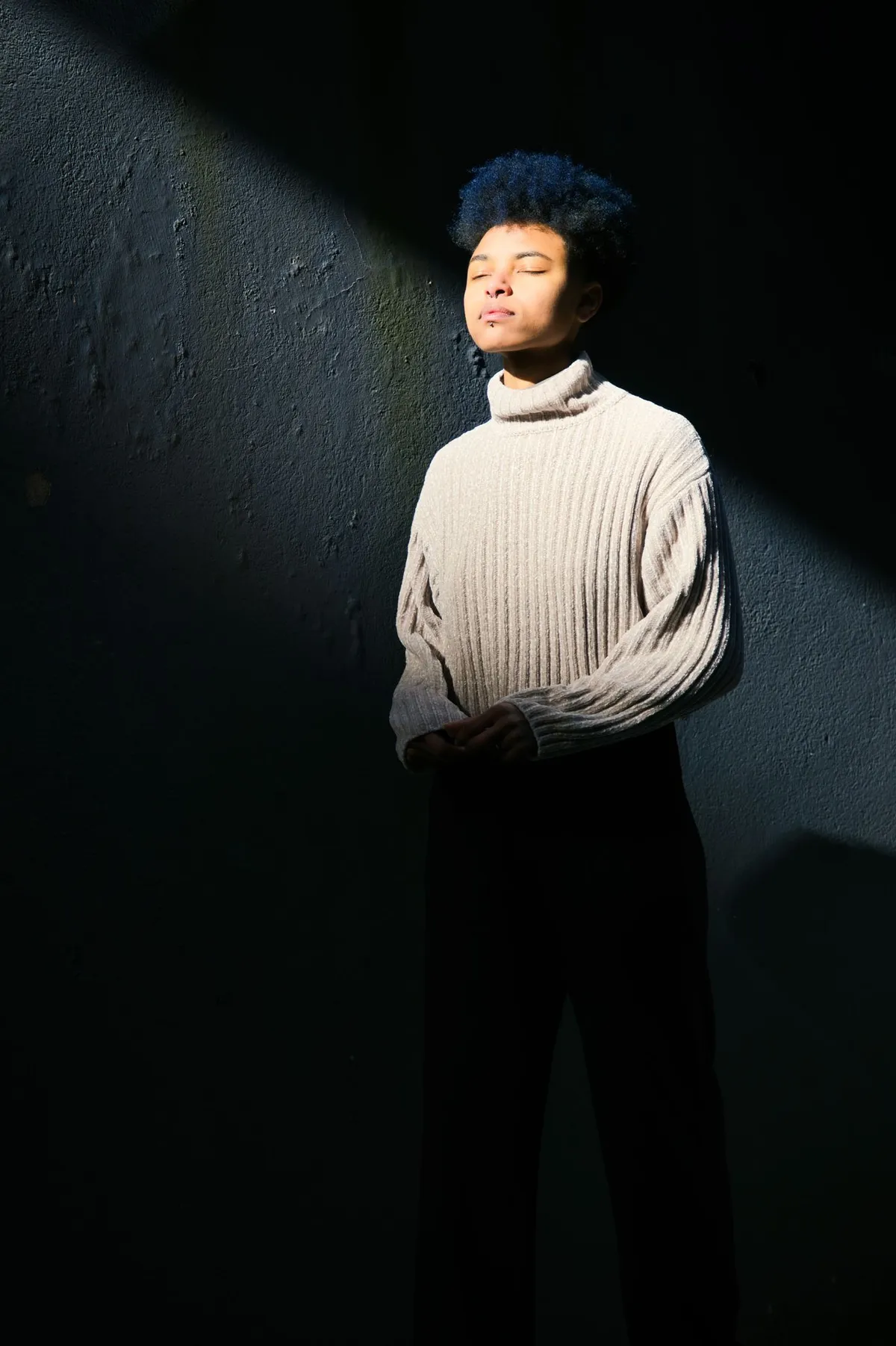
An open cardigan creates two visible edges around whatever you wear underneath. Those edges can make a simple top feel more deliberate, or repeatedly fall across a detail you wanted to show. Instead of beginning with a rule about which neckline belongs with knitwear, try the actual cardigan and base layer together. The useful question is how that particular opening behaves while you move.
Give the base layer a clear role
Put on the top, dress or shirt you intend to wear beneath the cardigan. Arrange it as you would for the day, including any tuck, fastening or visible neckline. Then add the cardigan without immediately adjusting both pieces. Notice what remains visible at the centre: a plain panel, a line of buttons, a tie or a patterned section. Decide which of those details you want the opening to frame.
If the base has a strong central detail, try letting it be the main point of interest. A cardigan front that repeatedly crosses a blouse tie may make you rearrange the combination more than you enjoy wearing it. That is an observation about these two garments, not a reason to reject every similar neckline. A simpler base layer may solve the problem without changing the cardigan at all.
Watch the opening during movement
Walk across the room, sit down and reach for something at an ordinary height. Look at where the fronts settle afterwards. Some openings stay broad; others fall inward or slip towards the shoulders. Try carrying your intended bag as well, because a shoulder strap can change how one front hangs. Use these movements to discover whether the combination needs frequent attention.
Make one adjustment at a time. You might smooth the base layer, change the cardigan position or try a different top length. Changing all three at once makes it difficult to see what helped. If you prefer to push up the sleeves, do that during the trial rather than judging only the neat arrangement you made in front of the mirror. The finished outfit should include the way you actually wear its layers.
Choose the opening you can leave alone
Check the result from the front and from a seated angle. The opening does not need to be perfectly symmetrical to work. What matters is whether the centre looks intentional to you and whether the garments remain comfortable in the positions they naturally take. A slightly softer arrangement can be more practical than a precise shape that disappears as soon as you move.
Record a useful pairing in ordinary language: pale cardigan over a plain crew-neck top, for example, with the sleeves worn down. A photograph can support that note, but include the garments' identities so you can repeat it later. When the same cardigan seems difficult on another day, return to the proven pairing before assuming that a new layer is needed. One dependable base can make an existing knit far easier to use.
Related reading
The Layering Pieces That Earn Their Space in a Small Closet, A Neutral Wardrobe With Enough Color to Feel Like You.